TodayBuildContextBrowseMore
stackBETAv0.1
TodayBuild a stackCommon stacksEncyclopediaPulse
Methodology
← Back to your stack
Monograph
PENDING · FEB 2027P-040
Cognition

DIHEXA

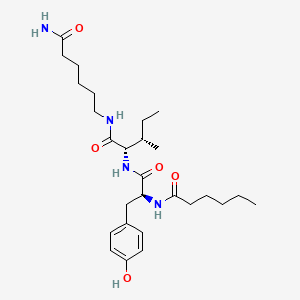
Six-amino acid HGF (hepatocyte growth factor) mimetic. Crosses BBB orally; promotes synaptogenesis in animal models.

ExperimentalCognition
Typical dose8-45 mg
Frequencydaily, oral
Half-life8h
Citations indexed13
DeliveryInjectable
Half-life~8h
EvidenceExperimental
Citations13
Similar compounds
Synergy checkCompareReconstitution calc
Experimental

Evidence is experimental. Most claims trace to limited human studies or animal models. Treat as a research direction, not a protocol.

Mechanism

Washington State University (Harding lab) candidate. Preclinical models show ~7-orders-of-magnitude greater potency than BDNF for synaptogenesis. Patented; M3 Biotechnology / Athira Pharma developed related candidates. No published human trials of DIHEXA itself.

Specifics
Brain fogFocus / attentionMood
Caveats

No human safety data. Strong synaptogenic effect in rodents could plausibly drive un-modeled CNS adverse effects in humans. Identity verification poor.

sequence · 3 aa
XYI

norLeu-Tyr-Ile-(6)-amido-hexanoic acid. Modified scaffold.

Evidence levelExperimental
Regulatory statusFDA Cat. 2 removed Apr 2026 — PCAC review Feb 2027
DNA / pharmacogenomicsLow — No PG.
Where the experts disagree

Stack doesn't rank peptides — we surface the diversity of opinion. Each card paraphrases a public-record stance from a named source. Where they conflict is where you should slow down and read both.

Research labDr. Joseph Harding laboratory, Washington State University

Harding lab developed Dihexa as an angiotensin-IV-derivative analog for cognitive disorders. Pre-clinical data shows synaptogenic activity ~7 orders of magnitude greater than BDNF in vitro. The lab has published primarily on rodent models; human clinical trials are absent.

RCT / meta-analysisWestern peer-reviewed cognitive-peptide literature

No human Phase 2/3 trials registered. The synaptogenic-magnitude claim is from in-vitro data and has not been translated to clinical outcomes. PCAC review scheduled February 2027 — until then, Dihexa is research-grey only.

Claims & evidence

Per-claim grading. Each claim is graded independently — same peptide, different claims can carry different grades.

  • DMechanistic / anecdotal

    DIHEXA — primary mechanism: six-amino acid hgf (hepatocyte growth factor) mimetic. crosses bbb orally; promotes synaptogenesis in animal models.

    1 supporting referencesVerified 5d ago
References

External links to PubMed searches, ClinicalTrials.gov, and FDA materials. We do not host papers — we point at canonical sources.

  • PubMedEN
    REVIEWFunding undisclosedVerified 5d ago
    PubMed — DIHEXA HGF mimetic
Reconstitution calculatorDIHEXA

Pre-filled with this compound's published dose range: 8-45 mg · daily, oral

Concentration2.50 mg/mL
Draw volume10.600 mL
Insulin syringe1060.0 u
Doses per vial0
U-100 syringe — fill to indicatorU-100 · 1 mL
0u25u50u75u100u
Watch

Draw volume exceeds 100 units (1 mL). Either reduce dose or split into multiple injections.

Calculator is a discussion tool. Verify reconstitution + dosing with a qualified provider. Stack is not a prescription source. Use sterile technique and inspect every vial.

PENDING · FEB 2027P-040

FDA Cat. 2 removed Apr 2026 — PCAC review Feb 2027

Feb 15, 2027USScheduled reviewUpcoming

PCAC review · February 2027 panel

FDA's Pharmacy Compounding Advisory Committee scheduled to review the second cohort of peptides removed from Category 2 in April 2026. Panel votes whether to add each to the official 503A bulks list.

Apr 15, 2026USTier change

FDA removes 12 peptides from Category 2 'significant safety concerns' list

FDA published a Federal Register notice on April 15 2026 removing 12 peptides from the Category 2 ('significant safety concerns') compounding list, paving the way for PCAC review for inclusion on the 503A bulks list. Peptides removed: BPC-157, TB-500, Epitalon, GHK-Cu (injectable), MOTS-c, DSIP, Dihexa Acetate, MK-677, Melanotan II, KPV, Semax, LL-37.

FDA Federal Register · April 15 2026 →
Nov 2023USBan

FDA places peptides on Category 2 'significant safety concerns' list

FDA's Pharmacy Compounding Advisory Committee categorized a wide list of peptides as Category 2 ('significant safety concerns'), effectively banning their compounding at 503A and 503B pharmacies. Affected: BPC-157, TB-500, Epitalon, GHK-Cu, MOTS-c, DSIP, Dihexa, MK-677, Melanotan II, KPV, Semax, Selank, LL-37 and others.

DIHEXA8-45 mg · daily, oral
Discussion guide, not prescription

stack is an exploration engine. Output is a discussion guide for a conversation with a licensed provider — never a prescription, dose recommendation, or sourcing instruction. Peptides discussed include compounds with limited human evidence and varying legal status by jurisdiction. Verify everything with a qualified clinician before any decision.

Full terms →
stackv0.1
AudiencesWho Stack is forFor researchersFor pharmaciesFor cliniciansFor press
Trust & regulatoryCalibrationMethodologyFDA statusPharmacy registryPCAC commentMX · COFEPRIS
Built honest. Bilingual from day one.