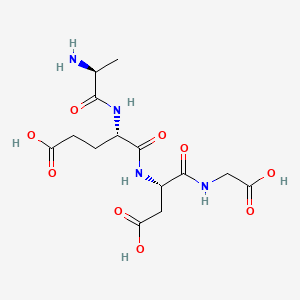
Khavinson lab's core claim is that Epitalon (and the broader Khavinson-peptide family) extends lifespan in elderly populations via telomerase activation and pineal regulation. Decades of Russian-language publications. Western validation absent; replication attempts limited.
Epitalon
Tetrapeptide thought to upregulate telomerase. Long-term human evidence limited.
Evidence is experimental. Most claims trace to limited human studies or animal models. Treat as a research direction, not a protocol.
Ala-Glu-Asp-Gly. Russian-developed. Animal and small Russian human studies report telomerase activation and pineal gland modulation. Western replication is sparse. Most longevity claims trace to a single research lineage.
Western clinical evidence is thin. Most peer-reviewed literature is from a small Russian research group (Khavinson). Source quality from grey-market vendors varies considerably.
Stack doesn't rank peptides — we surface the diversity of opinion. Each card paraphrases a public-record stance from a named source. Where they conflict is where you should slow down and read both.
F-tier — "biohackers' wet dream... the human studies are extremely thin and inconsistent. It really hasn't been shown in any substantive way to do what it's supposed to do." Recommends GHK-Cu or growth hormone secretagogues instead for anti-aging.
No registered Phase 2/3 trials of Epitalon for any indication in Western databases. Mechanism claims (telomerase activation in vivo) are not supported by independent replication. The Khavinson-lineage publications stand outside the Western peer-review system.
Source →Per-claim grading. Each claim is graded independently — same peptide, different claims can carry different grades.
- DMechanistic / anecdotal
Epitalon — primary mechanism: tetrapeptide thought to upregulate telomerase. long-term human evidence limited.
3 supporting referencesVerified 5d ago
External links to PubMed searches, ClinicalTrials.gov, and FDA materials. We do not host papers — we point at canonical sources.
Pre-filled with this compound's published dose range: 5-10 mg · daily for 10–20 days, cycled
Draw volume exceeds 100 units (1 mL). Either reduce dose or split into multiple injections.
Calculator is a discussion tool. Verify reconstitution + dosing with a qualified provider. Stack is not a prescription source. Use sterile technique and inspect every vial.
How much a first cycle actually costs across the channels people use. Pick the protocol length you're considering — Stack multiplies the monthly band by cycle weeks. Same caveats apply: ranges are facts, quality varies, this is not legal advice.
Numbers reflect publicly-advertised price ranges, not vendor quotes. Insurance, prescription costs, and shipping aren't included. Channels marked unavailable are filtered out.
See pharmacies for this compound →Approximate monthly cost across the channels users actually consider — brand FDA-approved retail, US 503A compounding, Mexican pharmacies, MX farmacias magistrales, and the research-grey market. Stack lists ranges, not vendor names. Quality varies wildly across channels — see each band's note.
Russian-source predominantly. Bodybuilder-coach Eric Janicki rated F-tier April 2026 — thin human evidence. Price reflects supply, not validated efficacy.
As of 2026-04FDA Cat. 2 removed Apr 2026 — PCAC review Jul 23-24, 2026
PCAC review · July 23-24 2026 panel
FDA's Pharmacy Compounding Advisory Committee scheduled to review the first cohort of peptides removed from Category 2 in April 2026. The 7 peptides on this docket are the highest-profile community names — BPC-157, TB-500, MOTS-c, Epitalon, DSIP, Semax, KPV.
FDA removes 12 peptides from Category 2 'significant safety concerns' list
FDA published a Federal Register notice on April 15 2026 removing 12 peptides from the Category 2 ('significant safety concerns') compounding list, paving the way for PCAC review for inclusion on the 503A bulks list. Peptides removed: BPC-157, TB-500, Epitalon, GHK-Cu (injectable), MOTS-c, DSIP, Dihexa Acetate, MK-677, Melanotan II, KPV, Semax, LL-37.
FDA places peptides on Category 2 'significant safety concerns' list
FDA's Pharmacy Compounding Advisory Committee categorized a wide list of peptides as Category 2 ('significant safety concerns'), effectively banning their compounding at 503A and 503B pharmacies. Affected: BPC-157, TB-500, Epitalon, GHK-Cu, MOTS-c, DSIP, Dihexa, MK-677, Melanotan II, KPV, Semax, Selank, LL-37 and others.